Integration guide
Connecting a DCS to RIMX over OPC UA
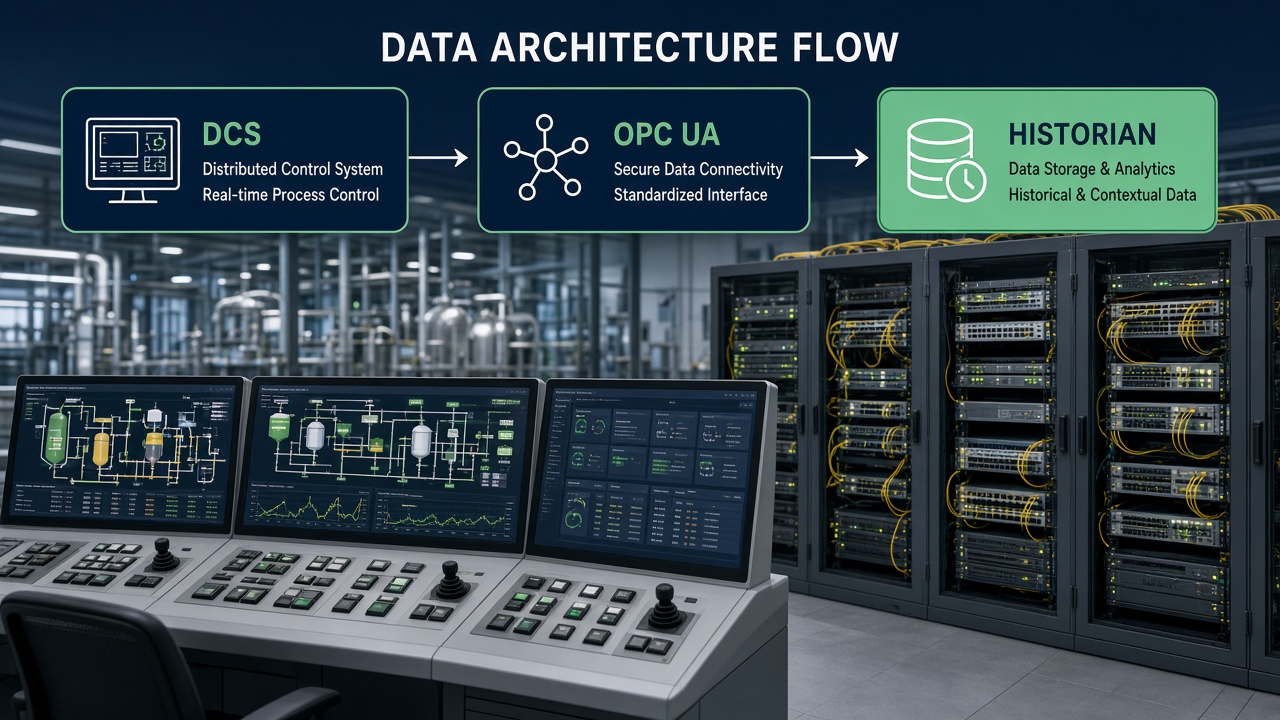
OPC UA (IEC 62541) is the practical way to get live and historical process values out of a modern DCS without DCOM. ABB 800xA, and most other current DCS lines, expose an OPC UA server for data access; many also expose Historical Access and alarms. RIMX sits on the other side as an OPC UA client: subscribe to tags, store them in the historian, then trend, dashboard, Excel and Python on that copy.
Two documents are worth reading before the first firewall ticket: the OPC Foundation’s Practical Security Recommendations for building OPC UA Applications, and the NAMUR/ATP working-group position on OPC UA in process automation systems (December 2024). The latter lists the use case that matches this article — DCS data to a plant information / historian layer (their C6) — and the availability and security requirements that plants actually hit.
What to connect, in order
- Agree the information model, not a tag dump. Start with the unit’s KPI and APC candidates: feeds, products, duties, qualities, modes, a handful of constraints. A 5,000-tag “copy the DCS” job is how historians become untrusted.
- Endpoint and discovery. Get the DCS OPC UA URL (often
opc.tcp://…:4840), the security policy the site allows, and whether a Global Discovery Server is in use. ATP’s 2024 requirements expect discovery (OPC 10000-12) and a redundancy story — transparent if the DCS supports it, otherwise a documented failover. - Security mode. Across a zone boundary, OPC Foundation guidance is SignAndEncrypt with X.509 application certificates — not “None” even on an “isolated” VLAN. Exchange and trust certificates explicitly; do not click through on first connect in production.
- Identity and rights. A dedicated, least-privilege account or certificate for RIMX. Browse and Read (and Historical Read if you backfill). No Write, no Call Method on control objects unless a later project has a change request for setpoint download.
- Subscriptions for live data. Publishing interval matched to the process (1 s on a flow, slower on a tank). Monitored items with deadband where the DCS allows it, so you do not soak the controller CPU. ATP: control tasks must stay higher priority than UA traffic.
- Historical Access if you need a backfill. OPC 10000-11 (release 1.05.04, 15 October 2024) is the HA specification: timestamped values with status, so a historian client can retrieve what a live subscription would have seen. Use it for commissioning backfill, not as the only collection path.
- Time, units, status. NTP on both sides. Engineering units in the UA node, not only in a spreadsheet. Map Bad/Uncertain so RIMX does not treat a frozen last-good value as process truth.
- Alarms and events (optional second phase). Useful for downtime KPIs; do not block the analogue historian on AE mapping.
A commissioning sequence that usually works
Stand up RIMX on the operations network (or IDMZ) with no route into controllers except the UA conduit. Trust certificates. Browse a sandbox node. Subscribe ten tags. Confirm values, timestamps and status against the DCS faceplate for a shift. Then expand the list from the agreed typicals. Only after live data is trusted, run HA backfill for the baseline window you need for KPIs or APC.
If the DCS still only offers OPC Classic, put a UA wrapper in the OT zone and treat that wrapper as the server RIMX sees. Do not punch DCOM through a firewall.
Sources
- OPC Foundation, OPC 10000-11, OPC UA Part 11: Historical Access, 1.05.04 (2024-10-15). specification
- OPC Foundation, “Practical Security Recommendations for building OPC UA Applications.” PDF
- NAMUR / ATP WG 2.1, “Requirements for the Implementation of OPC UA in Process Automation Systems,” 2024-12-03. PDF
- IEC 62443-3-2 (zones and conduits); NCSC, OT architecture principle 4 (2025 update).
- ABB, System 800xA OPC UA connectivity (DA / History / client–server roles).