Industrial data & AI
Why industrial AI starts in the process historian, not the data lake
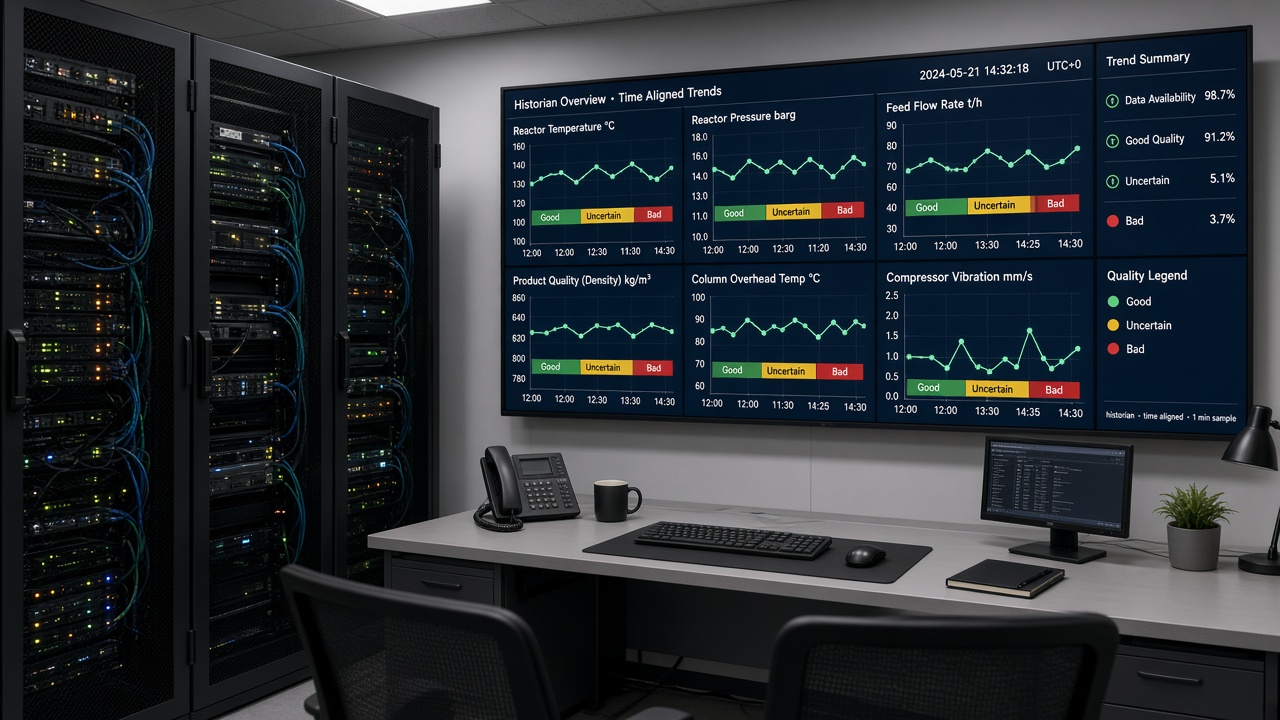
Most “AI on plant data” projects fail before the first notebook. Tags leave the DCS as a CSV or a lake table with a timestamp that looked fine in IT, and nobody kept the OPC quality, the engineering units, or the production-mode bit. The model then learns shutdowns as process behaviour, or treats a frozen transmitter as a golden batch.
That is why Autonomous Possible leads with RIMX: a lightweight process data platform where historian, Python analytics, dashboards and APIs sit on one copy of the series. Industrial AI is a consumer of that copy, not a reason to bypass it.
What the research actually says
A 2024–2026 wave of surveys is unusually consistent. Liu, Zhang, Sun, Cai and Wang’s state-of-the-art review of industrial time-series analysis in ACM Computing Surveys (accepted 2026) covers statistical methods, machine learning, deep learning and large models — and still lists data structure, causality and hybrid plant pipelines as the open gaps, not a shortage of architectures. A 2025 survey of deep multivariate time-series anomaly detection in Sensors (Wang, Jiang, Zhang et al.; doi 10.3390/s25010190) likewise treats industrial equipment faults as a time-and-variable problem: you need both the clock and the relationships among tags. A structured review of real-time industrial anomaly detection in Computers & Industrial Engineering (2025) found the literature scattered across idiosyncratic stacks, which is exactly what happens when every site rebuilds features in a lake.
None of those papers say “put GPT on the DCS.” They say industrial series are multi-rate, mode-switching, and labelled by status. That is historian language.
What to store if you want models later
- One clock. NTP on DCS and RIMX. Interpolate on purpose, not by accident.
- Status with every value. OPC UA Good / Uncertain / Bad. Drop Bad before sums and before training.
- A mode or run-state tag that operations agree on. Train and score only in the modes you named.
- The same mapping for live and history. A model trained on renamed tags will silently die after a DCS load.
- Python next to the series so KPI, soft sensor and residual live in RIMX — dashboards and Excel cannot drift from the training set.
When a site already has a PI-class archive and truly needs that retrieval scale, CCI CAKE remains in the portfolio. For new digitalization we still start with RIMX, because the bottleneck is almost never “not enough tags in the lake.” It is “nobody can recompute last month’s specific energy with the same rules as the model.”
A first AI use that does not need a data-science team
Put three calculations on the historian: production-mode mask, a unit KPI (see our Python KPI note), and a residual against a simple baseline (last 90 days of the same mode). Alert by email or LINE when the residual stays high for a shift. That is already industrial AI in the sense the surveys describe — time-series methods on plant data — and it is the on-ramp to soft sensors, APC baselines and later models.
Questions engineers ask
Can we skip the historian and train models on a data lake?
You can dump values, but you usually lose OPC quality, clock alignment and production mode. Reviews of industrial time-series methods keep finding that this context, not the model family, is what fails in the plant.
Does a Unified Namespace replace the historian?
No. A UNS holds current state. A historian holds history with timestamps and status so you can baseline, train and audit. MQTT or REST can feed both.
Where does RIMX fit versus a PI-class archive?
RIMX is the lightweight platform we recommend for new programs: historian plus Python, dashboards and APIs on the same data. CCI CAKE remains available when a site specifically needs extreme tag scale.
Sources
- L. Liu, Y. Zhang, Y.-N. Sun, H. Cai, C. Wang, “A State-Of-The-Art Review of Industrial Time Series Data Analysis: Methods and Applications,” ACM Computing Surveys (accepted 27 July 2026). doi:10.1145/3844497
- “A Survey of Deep Anomaly Detection in Multivariate Time Series,” Sensors 25(1):190 (2025). doi:10.3390/s25010190
- “AI-based real-time anomaly detection in industrial engineering,” Computers & Industrial Engineering (2025). doi:10.1016/j.cie.2025.111236