Engineering insight
When does APC pay back? A practical checklist
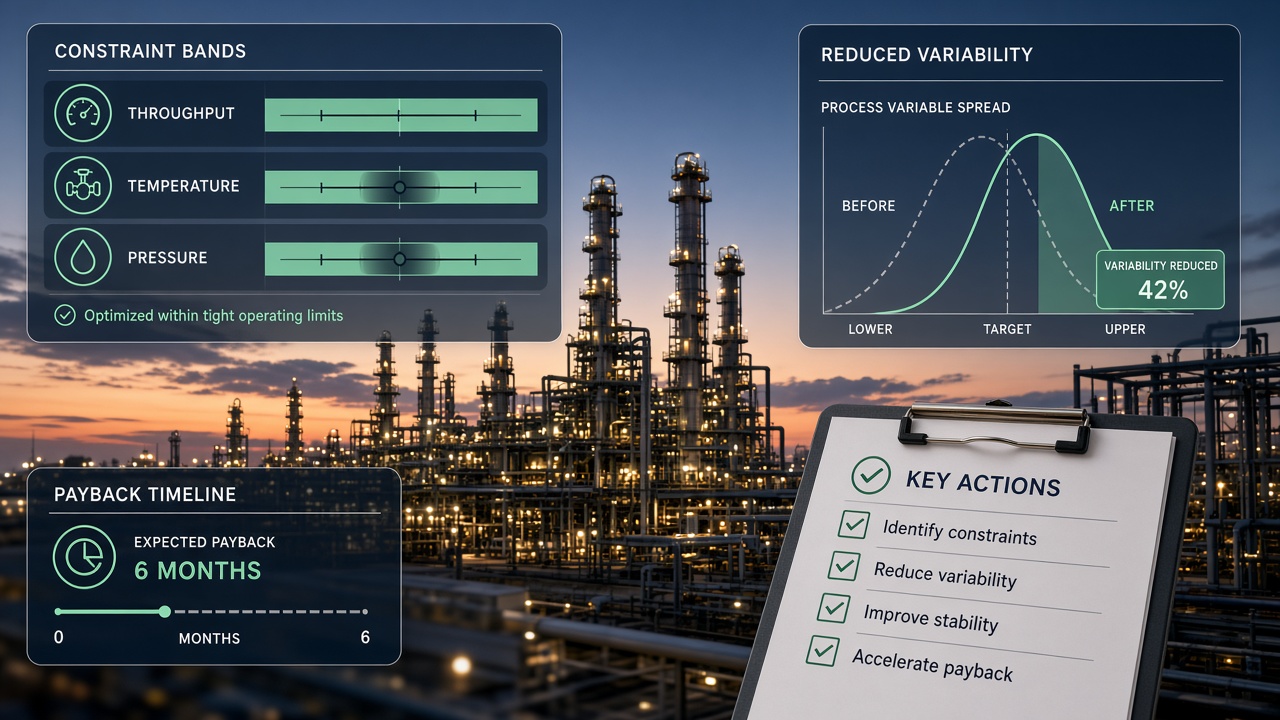
Vendors quote payback in months. Operators remember the last multivariable controller that was switched to manual after a turnaround. Both can be true. The literature is unusually consistent on the economics and on the failure mode.
Bauer and Craig’s survey in the Journal of Process Control (2008) remains the standard framework: benefits come from moving closer to constraints once variance falls — throughput, yield, energy, quality, emissions. Reported ranges that keep turning up in industry papers and case studies:
- Typical capacity lift on a well-chosen unit: about 3–5%; energy savings often cited in the 1–4% band (industry summaries compiled for AIChE).
- Project payout commonly a few months to about two years. AIChE 2020 (Mayo et al. on APC capital) cites 4 months to 2 years.
- Recent published examples still land under six months when the lever is steam or energy: Honeywell’s SARAS / Sarlux energy-optimisation work (systems in place January 2024) reported ~10% steam savings and ROI in less than six months; AspenTech’s BPCL Mumbai ARU digital-twin / APC case reported >$1M/year steam savings and payback under six months.
- The trap: more than 65% of APC applications lose their benefit and are effectively off within 18–24 months if models are not maintained (Mayo / Control Global, drawing on Shook, Fiske/ARC and related sources).
Checklist before you buy a controller
Use this as a go / no-go with production, process engineering and automation in the same room. It aligns with published APC readiness lists (for example Noga’s self-assessment) and with Bauer–Craig’s insistence on an economic performance function, not only a controller performance index.
- One primary KPI with units. t/h, kWh/t, yield %, spec sigma — not “run better.” You know what “worth it” means in money.
- A baseline window. 3–12 months of historian data at a scan that matches the dynamics, with modes, incidents and lab quality reconstructable.
- A binding constraint. Feed max, furnace duty, column flooding, emissions, quality cliff. If the unit is unconstrained, fix the bottleneck first.
- CVs and MVs on paper. Including which PID loops APC will write setpoints or biases into, and which constraints stay with the DCS.
- Sensors and valves that can close a loop. Calibration, stiction, analyzer delay. You can run limited step tests without violating safety.
- Regulatory layer in decent shape. Unstable or saturating PIDs will be blamed on APC within a week.
- Safe write path. Bumpless transfer, output limits, fallback to last DCS setpoints, APC off on trip. Control tasks stay higher priority than the OPC/API link (NAMUR/ATP process-automation OPC UA requirements, 2024).
- A named owner and a maintenance budget. Model health after crude switches, catalyst cycles, fouling. Without this, the 18–24 month fade is the expected outcome, not bad luck.
- Operator training as part of commissioning — not a slide deck after handover. Advisory / shadow mode before closed loop.
- Payback math that includes sustainment. Implementation plus one to two years of support, compared with the captured slice of the opportunity (the same realisation idea as in a plant value calculator).
When it usually does not pay
- The “problem” is a missing measurement or a valve that cannot move.
- Benefits were estimated from vendor typicals with no site baseline.
- APC writes to a DCS that the site will not let anyone change after a cyber review.
- Success is defined as “controller on %” instead of movement of the money KPI.
If those items are red, spend the next quarter on data, loops and constraints. That work is not a delay — it is the first year of APC benefit, done without a multivariable licence. RIMX is useful here even before an APC project: the same historian tags become the baseline, the step-test archive, and later the online KPI that proves the controller is still earning its keep.
Sources
- M. Bauer, I.K. Craig, “Economic assessment of advanced process control – A survey and framework,” Journal of Process Control 18 (2008) 2–18. doi:10.1016/j.jprocont.2007.05.007
- M. Bauer, I.K. Craig, E. Tolsma, H. de Beer, “A Profit Index for Assessing the Benefits of Process Control,” Ind. Eng. Chem. Res. 46 (2007) 5614–5623.
- S. Mayo et al., AIChE Spring 2020, “Advanced Process Control Capital Investment”; Control Global, “Plan ahead for APC maintenance.”
- Honeywell, SARAS / Sarlux energy optimisation case (ROI < 6 months, 2024); AspenTech, BPCL Mumbai ARU case.
- R. Noga, “APC readiness checklist (self-assessment),” PDF.