Discrete manufacturing
OEE and production monitoring — without buying a full MES first
Discrete buyers rarely search “process historian”. They search OEE dashboard, downtime tracking, production monitoring, and in Chinese OEE 看板, 停机分析, 离散制造. The underlying need is the same as a process plant: trusted time-series from the machines, not another spreadsheet after the shift.
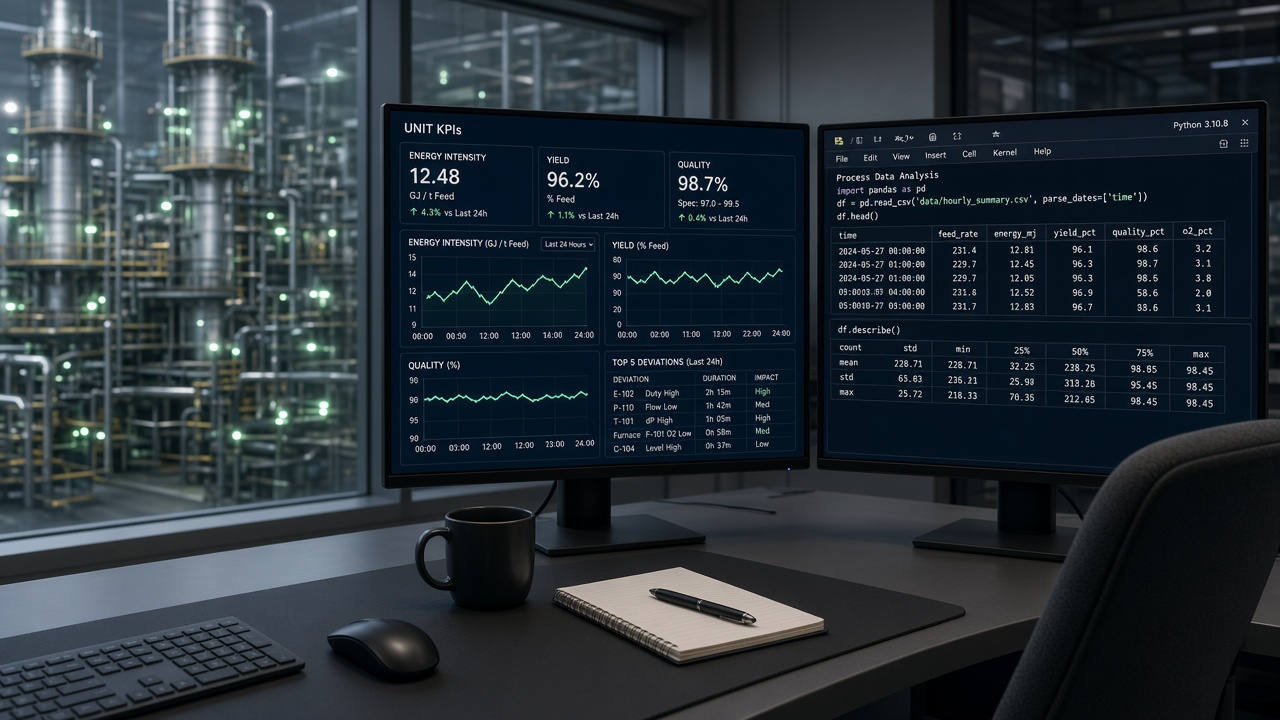
What a first line actually needs
- Run / stop (or andon) from the PLC or SCADA
- Counts or speed versus a planned rate
- Rejects or quality holds — even a simple good/bad bit
- A downtime reason list short enough that operators fill it
RIMX stores those tags, trends them, and lets engineers calculate OEE in Python next to the history. It is not a full MES: no work-order explosion, no infinite routing library. If you later add MES, the historian remains the record of what the line physically did.
How this differs from process plants
Process units need high-resolution analog history and operating mode for APC. Discrete lines need events, cycles and reasons. Same platform, different tag design. We still do not replace the PLC as the controller — same rule as industrial AI on a process unit.
Related notes: unit KPIs from historian tags, stop living only in Excel, first pilot: one line, 50–300 tags.
Questions production managers ask
We already have SCADA. Why a historian?
SCADA is the live picture. OEE and “why were we down at 02:00” need history you can query next week. SCADA is a poor archive.
Will operators fill downtime reasons?
Only if the list is short and the screen is next to the line. Ten vague codes beat eighty precise codes that stay empty.
Is this “AI + discrete manufacturing”?
Not yet. Capture first. Models on empty reason codes invent stories. After a few months of trusted OEE, anomaly and energy use become honest projects.