Technical note
How many tags belong in a first historian pilot?
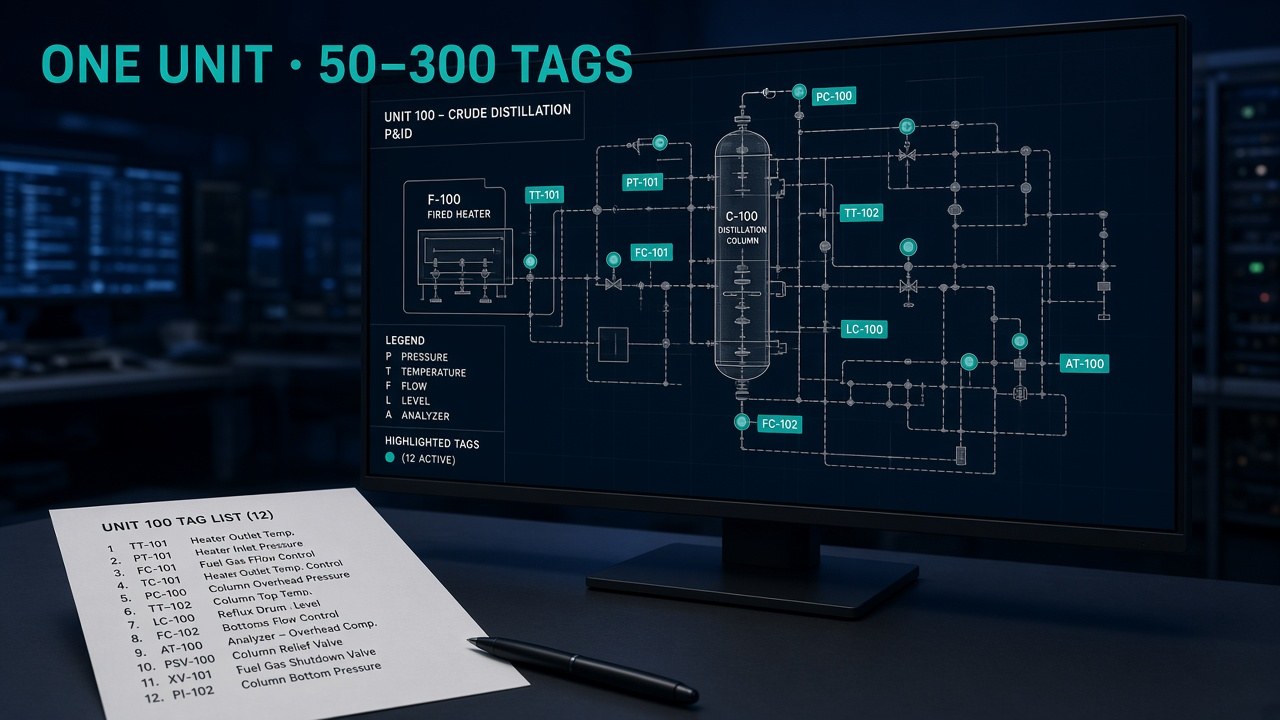
The judgement: start with one unit, about 50–300 tags, two to six weeks, and a single output operations already wants (yesterday’s energy, a golden-batch overlay, a downtime list). That is enough to prove a process historian / 实时数据库. It is not enough to replace a corporate data strategy — and it should not try.
Why a few hundred, not a few thousand: someone has to name each tag, confirm scan, confirm engineering units, and say whether it is meaningful in shutdown. That work does not scale linearly in a first month. OPC UA will happily subscribe to everything; your engineers will not happily own everything.
A tag list that survives contact with operations
- Every PV you already put on a board trend.
- The SP and OP of those loops (mode included).
- The 5–15 lab or quality points that argue with the board, even if slow.
- A handful of utilities: steam, fuel, power, feed — whatever the daily report already argues about.
- Explicitly not: every diagnostic bit on every drive, “just in case.”
Scan rates
Match the dynamics. Furnace pass temperatures at 1–5 s; a tank level at 10–30 s; a lab result when it arrives. Compress with deadbands you can explain. If you archive everything at 100 ms because the DCS can, you will spend the pilot on disks instead of on the report.
Connect read-only. Certificates and Historical Access are in Connecting a DCS to RIMX over OPC UA.
Questions
Is 50 tags too small to impress management?
It is the right size to finish. Management is more impressed by one energy KPI that matches the fuel invoice than by a 5,000-tag empty archive.
When do we add the rest of the plant?
When the first unit has an owner, a backup, and a report that survived a shutdown. Then copy the pattern, do not copy the tag dump.