Analytics
Soft sensors in RIMX: inferring quality when the analyzer is late
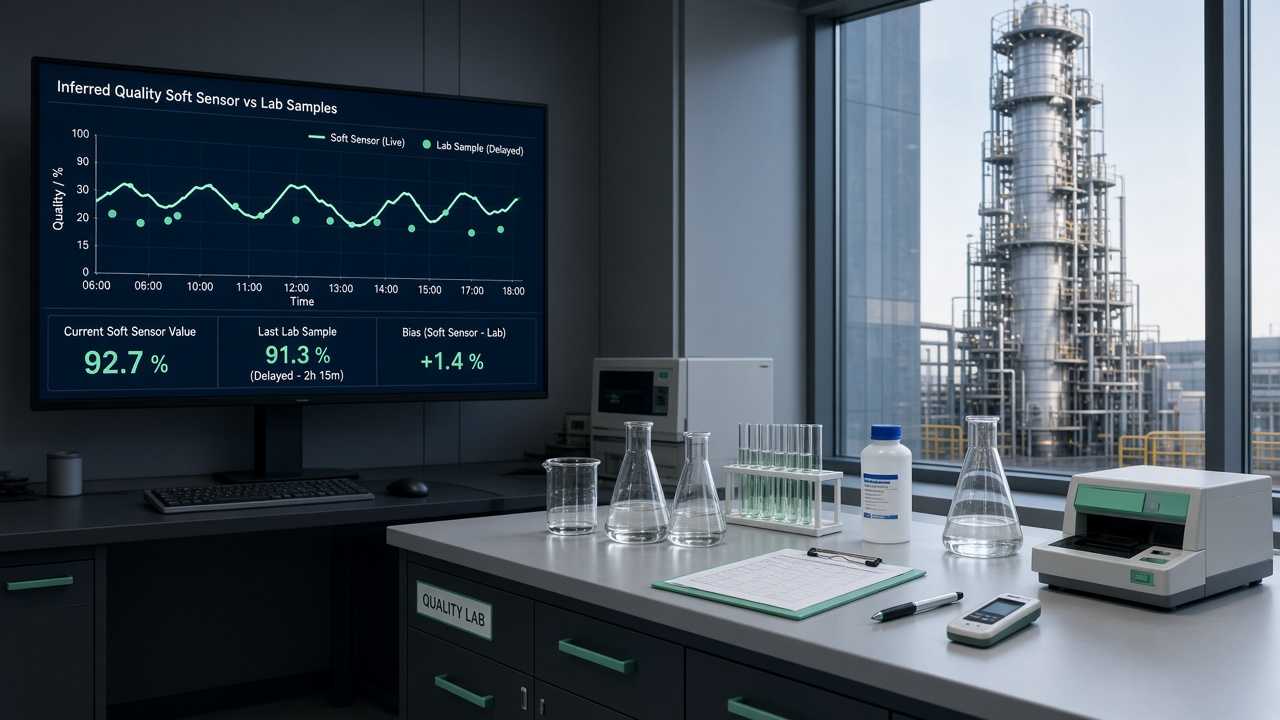
Process plants already know the problem: the quality that pays the bill is slow, sparse, or offline. RVP, viscosity, composition, particle size — the analyzer cycle or the lab queue is longer than the disturbance. Inferential sensors (soft sensors) estimate that quality from fast tags: temperatures, flows, pressures, duties. They are not new. What is new is that 2024–2025 process-control papers finally treat the ugly parts of plant data as the research problem: multi-rate samples, mode changes, and labels that arrive later than the process.
RIMX is where we put that work for clients: historian tags in, Python model on the same store, inferred quality as another trend next to the lab tag — never silently written into the DCS as if it were a certified measurement.
What recent papers changed
- Quality has to drive the features. Quality-driven stacked autoencoders (Journal of Process Control-adjacent work, 2024) exist because unsupervised deep features often ignore the lab tag you actually care about.
- Long delay is a transformer problem. Wang, Liu, Wang and Liu (EAAI, 2024) use a target-related Transformer so attention is pulled toward the quality variable, not just toward whatever varies most.
- Multi-mode time series. Gaussian-mixture TimeVAE with time-series decomposition (Journal of Process Control 147, March 2025) is aimed at industrial soft sensing when the unit has more than one regime.
- Labs are slower than the process. Interpretable disentangled transfer learning for multirate quality prediction (IEEE Transactions on Cybernetics, 2025) states the obvious plant fact: quality is sampled far less often than process tags, and most soft-sensor papers still pretend otherwise.
Read those as requirements, not as a shopping list of GitHub models. If your historian cannot join a 1-minute flow with an 8-hour lab sample and a mode bit, a Transformer will not save you.
A plant sequence that matches the papers
- Define the quality and the decision. “Give operators a 15-minute RVP estimate between lab shots” is a project. “Predict quality” is not.
- Pull aligned history from RIMX — process tags at a regular interval, lab as a sparse series, MODE = production. Drop Bad status.
- Fit a baseline humans can argue with (PLS / regularised linear) on a year of one grade or mode. Plot residual versus lab. If this is already useful, stop and deploy.
- Only then try a nonlinear or transfer model for grade changes and long delays — the 2024–2025 methods above.
- Show both tags on one dashboard: lab (sparse) and inferential (fast), with the last training date. Alert when they disagree for N samples, not when the neural net is “confident.”
Python inside RIMX matters because retraining is a historian query, not a new data-science extract. The same pattern as unit KPIs: mask, align, then model. Inferentials also feed APC and OTS later — a quality estimate is a CV you can at least monitor before you close a loop.
Questions engineers ask
Is a soft sensor a replacement for the analyzer?
No. It is an inferential between lab or analyzer updates, for monitoring and maybe advisory control. Certified quality and custody still come from the instrument.
Do we need a transformer network on day one?
No. Start with a mode-masked linear or PLS model on a few tags that process engineering already trusts. 2024–2025 deep models help when nonlinearity and long delay dominate — after the data path is clean.
How does RIMX help versus exporting to Python on a laptop?
The model, the live tags and the dashboard share one historian mapping. Retraining uses the same query as the KPI page, including status and mode.
Sources
- Y. Wang, D. Liu, K. Wang, C. Liu, “A task-oriented deep learning framework based on target-related transformer network for industrial quality prediction,” Engineering Applications of Artificial Intelligence 133 (2024). doi:10.1016/j.engappai.2024.108361
- Gaussian mixture TimeVAE for industrial soft sensing, Journal of Process Control 147 (2025) 103355. doi:10.1016/j.jprocont.2025.103355
- Interpretable disentangled transfer learning for multirate industrial quality prediction, IEEE Transactions on Cybernetics (2025). doi:10.1109/TCYB.2025.3591769