Engineering insight
Fix the PIDs before you buy APC
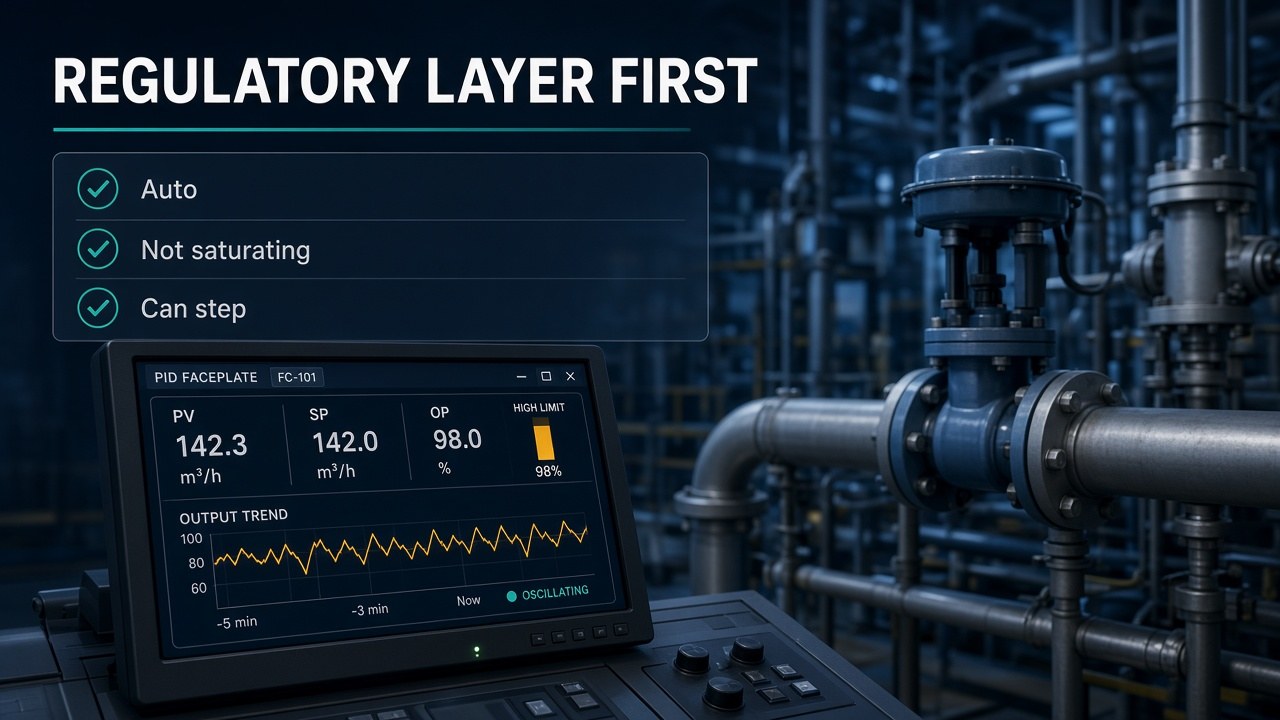
The judgement, up front: do not buy advanced process control until the loops APC will write into can hold a setpoint without hunting, saturating or waiting on a sticky valve. Vendors sell a multivariable model. What operators remember is the week after a turnaround when every MV sat on a limit and the controller was put in manual.
This is not a new observation. Surveys of regulatory performance have been bleak for decades: a large fraction of industrial PID loops are in manual, or in auto but saturating, or oscillating because of valve stiction or poor tuning (classic loop-audit literature from Desborough & Harris, EnTech, and later commercial loop-monitoring vendors). APC sits on top of that layer. If the base layer is sick, the MPC inherits the sickness and looks expensive.
What “healthy enough” means on a real unit
- The MVs can move. Valve travel, not just a green “auto” light. Stiction and oversized valves show up as a limit cycle the MPC will fight.
- The CVs are measured on a timescale that matches the loop. An analyzer with a 40-minute cycle is not a CV for a 2-minute MPC unless you have a soft sensor with a known delay.
- You are allowed to step. If the site will not permit small, documented steps on the loops APC will use, you cannot identify a model you should trust.
- Limits and fallback are already in the DCS. APC off must leave the unit in a legal, bumpless state. That is a DCS job, not a historian job.
A one-afternoon audit
Pick the 8–15 loops that would become APC MVs or inner cascades. For each: time in auto last month, time at output high/low, oscillation period, last calibration, last valve stroke. If more than a third fail, spend the quarter on loops and the historian baseline — not on an MPC licence. That work is the first year of APC benefit, done cheaper. See also when APC pays back.
Where RIMX fits
You need a process historian that keeps mode, OP, PV and SP with quality bits, or the audit is a screenshot contest. RIMX is enough for that audit on an SME unit. You do not need a 100,000-tag enterprise historian to find out that FV-2104 has been at 98% for six weeks.
Questions
Can we tune PIDs and commission APC in the same shutdown?
You can retune during a shutdown. You cannot prove the retune on a live constraint until you are back in production. Sequence: loops healthy in production → baseline → then APC.
Is loop monitoring software a substitute for APC?
No. It tells you which loops to fix. Fixing them often captures part of the energy/quality benefit people were hoping APC would buy.
- T.J. Harris, C.T. Seppala, L.D. Desborough, “A review of performance monitoring and assessment techniques for univariate and multivariate control systems,” J. Process Control (1999).
- M. Bauer, I.K. Craig, “Economic assessment of advanced process control,” J. Process Control 18 (2008).
- When does APC pay back? A practical checklist