Operator training
Replay plant history into operator training: RIMX and Apogee OTS
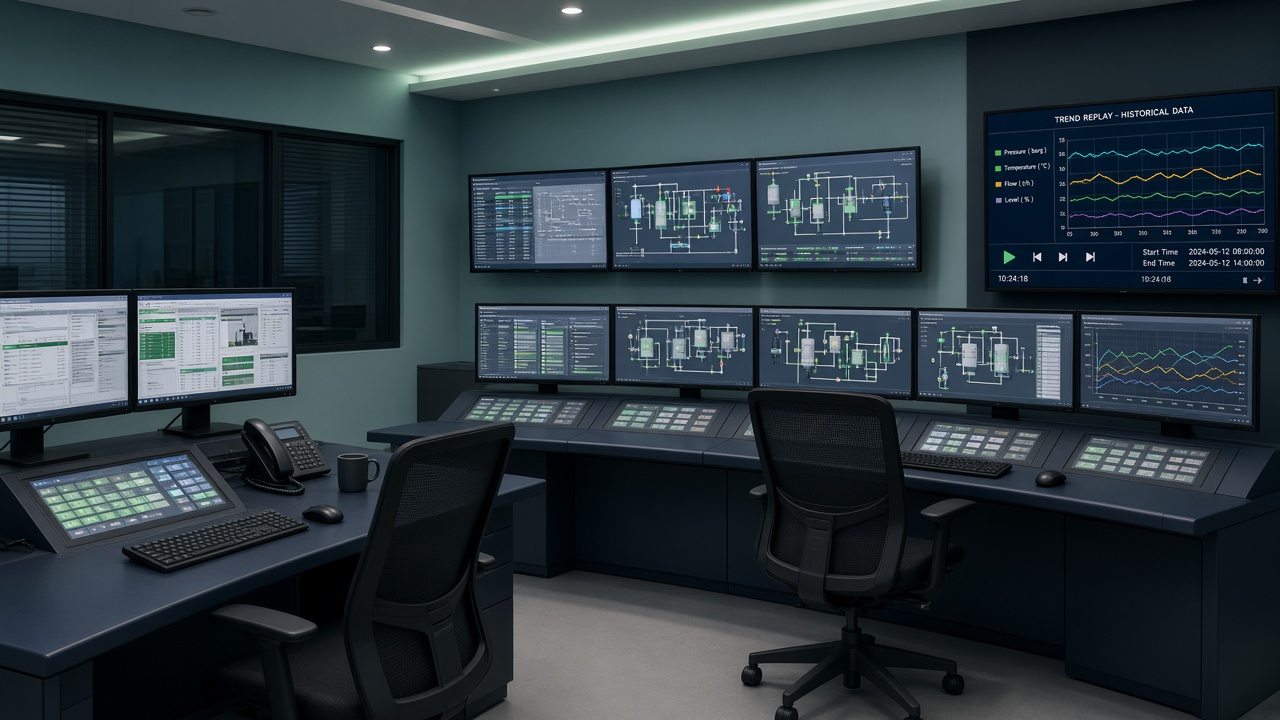
High-fidelity operator training simulators exist because a live unit is a poor classroom. Apogee OTS gives a virtual plant with DCS emulation, SIS and field devices so crews can rehearse start-ups, upsets and emergencies. The weak point on many sites is not the model. It is the scenario library: textbook disturbances that nobody on shift recognises, while last quarter’s compressor trip sits unused in the historian.
RIMX is that historian. Used together, the platform and the OTS close a loop the digital-twin literature often leaves open: evidence from operations becomes the lesson plan.
Why history belongs in the instructor station
Industrial time-series reviews (ACM Computing Surveys, 2026) treat process supervision as a primary application of stored series — not only model training. ISO 22400-style KPIs and energy baselines only mean something if operators have felt the same trajectory on a board. Replaying a RIMX window into an OTS case gives:
- The actual feed quality, not an assumed assay.
- The alarm flood that really happened, which is what you want people to practise clearing.
- Golden-batch traces as a visible target during grade changes.
- Post-run comparison: trainee KPIs versus the historical shift (specific energy, peak deviation, time to stable).
A working method
- In RIMX, tag incidents you already discuss in morning meetings: trips, slow ramps, off-spec campaigns.
- Export the window (process tags, modes, key alarms) as the scenario brief. Keep status so instructors do not replay Bad values as truth.
- Build or adjust the OTS case so the initial condition matches that window as closely as the model allows.
- Score the session on the same KPIs the plant uses in RIMX — not only “did they click the right faceplate.”
- Once a year, retire scenarios the unit no longer runs (revamp, catalyst, new constraint).
That is a lighter lift than a full online digital twin, and it is the one operators will attend. It also gives APC and soft-sensor projects a place to show a future CV before anyone closes a loop.
Questions engineers ask
Is this a digital twin?
A high-fidelity OTS is a training twin of the unit, with DCS emulation. RIMX history supplies the scenarios and the KPIs. It is not a licence to skip first-principles models for operator training.
What should we replay first?
Start-ups, trips, and the last grade change that went poorly — events you can find in RIMX. Then golden-batch traces as the target trajectory.
Do instructors need data-science skills?
No. They need a historian trend they trust and an instructor station. RIMX is the evidence locker; Apogee OTS is the practice plant.
Sources
- L. Liu et al., industrial time-series review, ACM Computing Surveys (2026) — process supervision as a primary application. doi:10.1145/3844497
- ISO 22400 manufacturing KPIs; process-industry gap analysis, Procedia Manufacturing 25 (2018).
- NAMUR Open Architecture (NE175): keep training and optimisation tools off the core control path.