Industrial AI
Anomaly detection on process data that operators will actually use
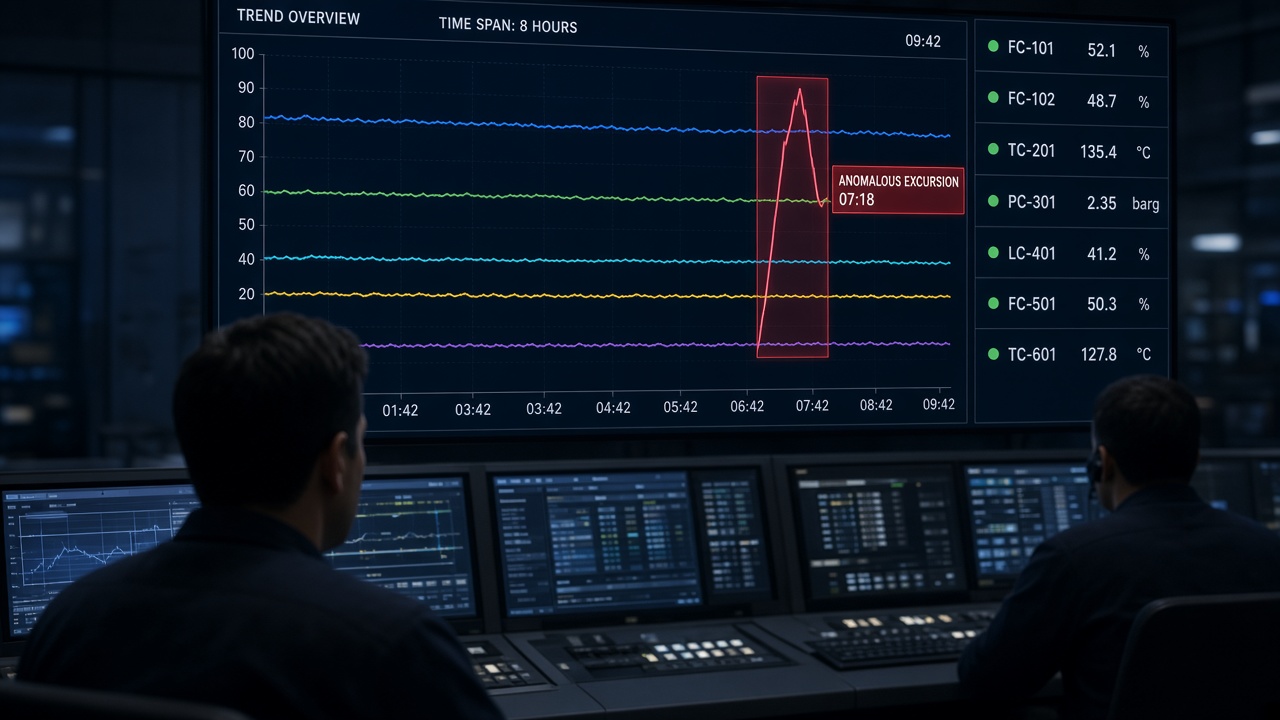
Anomaly detection is the industrial-AI use case every vendor leads with, and the one operators forgive least. A 2025 survey of deep multivariate time-series anomaly detection in Sensors catalogues dozens of architectures. A 2025 structured review in Computers & Industrial Engineering found real-time industrial methods scattered and hard to transfer. A 2024 survey of sensor-network time-series detection (Chinese Journal of Network and Information Security / DOAJ) stresses the mix of cyber events and physical faults in the same series. The practical conclusion is not “buy a bigger network.” It is: detect on series that still look like the plant.
On RIMX we treat anomaly detection as a historian application with an explanation, not as a black box watching every DCS point.
What fails in the control room
- Training on calendar time, including turnarounds, so “normal” includes being off.
- Ignoring OPC Bad/Uncertain, so a dead transmitter becomes a new cluster of “normal.”
- Scoring 5,000 tags so every alert is a soup of contributions nobody can check on a faceplate.
- No link to the last similar shift, so the operator has nothing to do except acknowledge.
Those failure modes are data problems. They are also why ACM’s industrial time-series review (2026) keeps returning to data structure and hybrid pipelines.
A RIMX pattern that survives contact with operations
- Pick the unit decision. “Warn if the hydrotreater looks unlike the last 90 producing days” is better than “AI on the site.”
- Choose 8–20 tags process engineering already uses: feeds, duties, key qualities, a constraint. Not the entire OPC browse tree.
- Mask by MODE. Fit a simple residual model (PCA, autoencoder, or even tag-wise robust z-scores) on production mode only.
- Threshold in engineering units where you can: residual energy, quality sigma, not only a 0–1 score.
- Write the alert in RIMX workflows to email or LINE with: timestamp, mode, top tags, link to the trend, last similar event if you store it.
- Review shelved alerts every month the same way you would review APC “controller on” time. If it is not changing a decision, turn the sensitivity down or kill the rule.
This is also how anomaly detection feeds APC and OTS. A repeatable excursion with a named cause is a candidate constraint or a training scenario. A nameless spike is just another alarm.
Questions engineers ask
Should we start with a deep multivariate model?
Not on thousands of raw DCS tags. 2025 reviews still show that industrial series need structure. Begin with a few CVs, a mode mask, and a residual operators can name.
How is this different from DCS alarms?
DCS alarms fire on limits. Historian anomaly detection looks at residual patterns across tags in a mode. Use it to catch slow fouling or a silent analyzer death, not to replace trips.
Can RIMX send LINE or email without a MES?
Yes. Low-code workflows on the historian are enough for a first alert path. Keep the message: unit, mode, tags, last similar event — not a model score alone.
Sources
- “A Survey of Deep Anomaly Detection in Multivariate Time Series,” Sensors 25(1) (2025). doi:10.3390/s25010190
- “AI-based real-time anomaly detection in industrial engineering,” Computers & Industrial Engineering (2025). doi:10.1016/j.cie.2025.111236
- Survey of time series anomaly detection for industrial sensor networks (2024). doi:10.11959/j.issn.2096-109x.2024050